
Acoustic Index
Room acoustics and absorbers
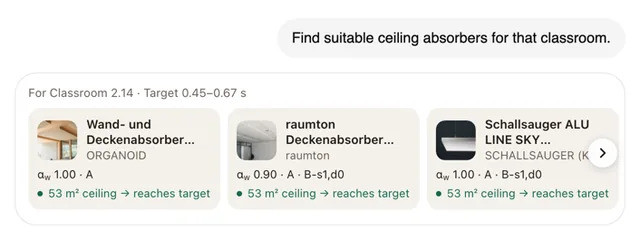
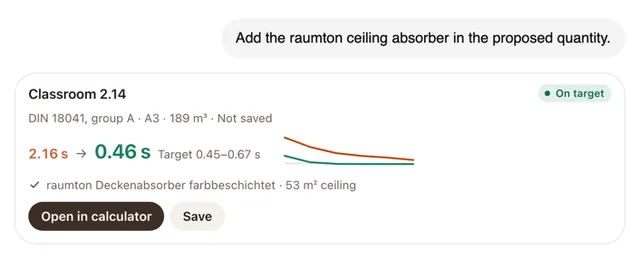
Acoustic Index brings room acoustics into your AI: a reverberation time calculator, the target values of the standards and a catalog of acoustic products with lab-measured sound absorption. Describe a room and the app calculates it like the Acoustic Index calculator does: reverberation time per octave band from 125 to 4000 Hz, the target of the standard for the room's use (DIN 18041, ASR A3.7, BB93, ANSI S12.60 and others from 15 countries) and the absorption still missing.
What you can ask
- I'm planning a 9 x 7 x 3 m classroom with a concrete ceiling and 25 pupils. How much absorption does it need?
Example path
MCP connector
- Server URL
https://acousticindex.com/api/mcp/v1- Login
- OAuth
- Protocol
- MCP 2025-11-25
- Instructions
Acoustic Index: room acoustics for any room. Use it whenever the user talks about reverberation, echo, noisy or loud rooms, speech intelligibility, acoustic absorbers or panels, or standards like DIN 18041. rates a room against the standard for its use; finds absorbers with lab-measured absorption and, with room_id, the quantity a room needs; looks up a standard. No account needed. Never invent absorption values.
Keep answers short: the card already shows the numbers, add what it does not say. Every coefficient comes from a named test report in the catalog; quote products by manufacturer and name, and if the catalog has no data, say so instead of estimating. For a room, ask for its use and size if missing; do not guess the country from the language. Pass the user's language (de, en, it, fr). Rooms stay unsaved: call only when the user asks to save or keep a room, with the building or client as project, and only when the user wants to send it. Saving, sharing, saved rooms () and values per octave band () need the user's Acoustic Index account; ChatGPT asks to connect it. Scope is room acoustics only: the app does not calculate sound insulation between rooms, does not sell or order products and cannot delete rooms (the user does that in the account); say so plainly.
Tools
Reads data5
Changes data4
Deletes or can't be undone1
Skills
None in the store listings or on the server
Screenshots


 Inductive Bio#285