
Trouve ton bien immobilier
Trouvez le bien qui correspond réellement à votre projet immobilier. Décrivez simplement votre recherche en langage naturel : budget, localisation, mode de vie, environnement ou critères spécifiques.
What you can ask
- Trouve-moi une belle maison à Cotignac
Example path
MCP connector
- Server URL
https://mcp.omny.fr/mcp- Login
- OAuth
- Protocol
- MCP 2026-07-28 · Interactive UI
- Instructions
Omny is a French real estate search assistant connected to nearly all agencies. Use to find listings with an explicit location. When returns disambiguation_needed, ask the user which commune they mean, then call the tool again with commune_code.
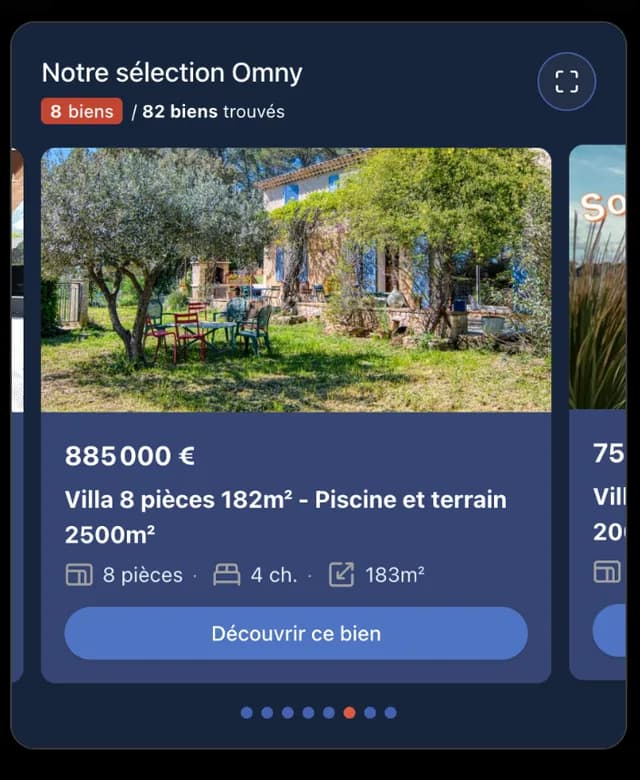
DISPLAY — after returns returned_count > 0 with a non-null search_id, you MUST call with that exact search_id (nothing else to pass). This renders the interactive property cards the user expects; never present the listings only as text. If search_id is null, the interactive display is temporarily unavailable — present the listings in plain text using the data already in this result instead. If reports the search has expired, re-run and call it again with the fresh search_id. When returned_count is 0 or disambiguation_needed is set, do NOT call — explain the situation in plain text and help the user refine or disambiguate. Results are ALWAYS ranked by relevance (graded 0-100 score); total_count is how many listings strictly match the criteria, so you can say e.g. 'about 120 listings match, here are the best ones'. returned_count can EXCEED total_count: the extra listings are close matches (relevance.matches_all_criteria=false) — present them as near-matches, never as exact ones. If returns an error asking whether the user wants to buy or rent, ask them and search again with tenure_modes set. After displaying, ask one targeted follow-up question when useful.
REFINEMENTS — when the user narrows or adjusts an ongoing search (e.g. adds a surface, a price or a room count), ALWAYS resend the FULL set of criteria already established, merged with the new input — never send only the changed field. Omit a criterion only if the user has not mentioned it.
VISIT FLOW — when the user message contains [listing_id:UUID], follow this exact sequence. NEVER ask for slots or phone in plain text — always use the widget tools:
Call — it returns the slot count AND phone_present (whether the user already has a phone number on file).
If phone_present is not true (false, or null when it could not be checked): call — the widget validates and saves the number itself. Wait for the follow-up.
If the slot count is 0 (no future slots): call — the user picks and saves slots directly in the widget. Wait for the follow-up.
If the tool is available and it has not been called yet in this conversation: call it once, prefilled ONLY with what the user explicitly said (budget, or monthly rent when renting, move-in timeline, usage, property to sell); use null for anything else and never guess. Always fill project_note with a summary for the agency of everything useful the user said in this conversation that the other fields do not capture (financing, current housing, household, must-haves, constraints, availability...): first person, in the user's language, 500 characters max, facts the user stated only. The user reviews, corrects and confirms it in the widget; every answer is optional. Wait for the user's next message: whether it confirms the project or simply carries on in the chat (for example asking again for the visit), continue with step 5 and never call again in this conversation. Never ask these questions in plain text.
Tools
Reads data10
Changes data7
Deletes or can't be undone1
Skills
9 in the ChatGPT listing
Screenshots


 realestate.com.au#707