
FounderBrain
Feedback on pitches and calls
FounderBrain gives you feedback on how you came across in a meeting, and coaching on what to try next time. Share the transcript of a fundraising pitch, VC or investor call, sales call, interview or practice run, exported from your meeting or transcription tool with speaker labels, then say which speaker is you, and FounderBrain compares how you spoke with 773 public interviews of founders and CEOs.
What you can ask
- Here's the transcript of my seed pitch yesterday. Run it through FounderBrain and tell me how I came across.
Example path ·
MCP connector
- Server URL
https://mcp.thinkreasonlearn.com/mcp- Login
- None
- Protocol
- MCP 2026-07-28 · Interactive UI
- Instructions
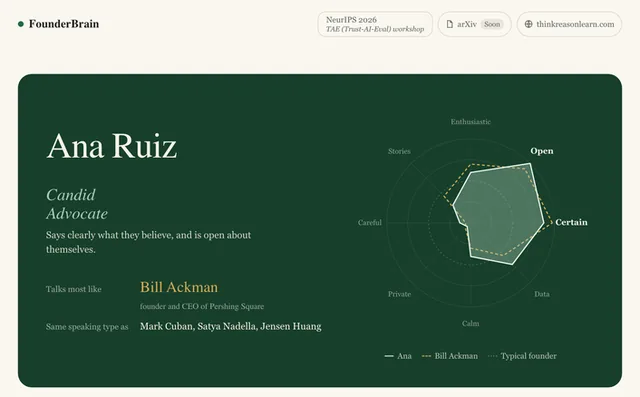
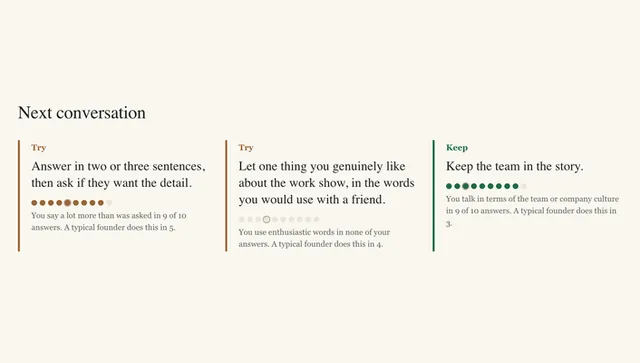
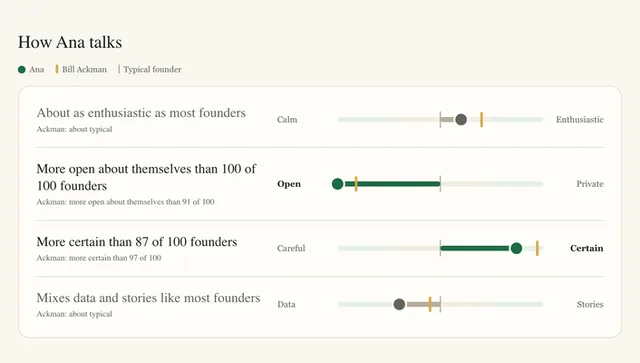
FounderBrain, powered by think-reason-learn, analyses one speaker in a meeting transcript (a pitch, investor call, sales call or interview) and compares how they talk with public interviews of founders and operators. It returns a speaking type, four style positions, well-known people with a similar style, standout habits and takeaways.
Before sending any transcript, including or an upload, inspect it in the current app or locally. Exclude payment-card data, government identifiers, passwords, API keys, authentication codes and protected health information. Also exclude sensitive personal information, such as a person's health, religion or ethnicity, which speaking-style coaching does not need. Ordinary business revenue or general healthcare discussion is not automatically restricted. Replace isolated sensitive values or short passages with [removed], preserving the surrounding speech and consistent speaker labels. Briefly name only the category removed, without asking for another confirmation or claiming complete detection. Never repeat removed details in tool arguments, filenames or coaching. If sensitive material is extensive or cannot be confidently separated, ask for a different excerpt or cleaned transcript and do not send it. User permission does not override these exclusions; never send the unchecked original as a fallback.
For an authorised request, briefly explain before the first transfer that the transcript goes to FounderBrain and the user must have the right to share it. This is a notice, not an extra confirmation; do not repeat it for the same transcript. Stop if the user indicates they lack that right. Self-coaching is the default unless they request someone else. Use an identified speaker or ask "Which speaker are you?" only if unclear. When analysing someone else, establish their knowledge and agreement to sharing the transcript with FounderBrain and analysing their speech, unless already given. If the user says no or is unsure, do not analyse that person. Self-coaching still requires the right to share the other speakers' words. For speaker listing only, do not ask which speaker to analyse or start an analysis.
runs the analysis in chat apps. It needs one speaker turn per line and the speaker label. Read the whole attached file, apply the checks above, then send the complete prepared transcript, never just a file preview. An excerpt chosen by the user is allowed; do not expand it. Do not summarise or rewrite speech beyond the removals. Calling first is optional and sends the text a second time. Count the prepared speech, excluding removal markers, against the word limits.
In Claude Code, Codex or another client that runs commands on the user's own computer, when the transcript is a local .docx, .txt, .md or .vtt file, read and prepare it locally first. Create a temporary .txt copy containing only the prepared speaker turns, leaving the original unchanged. Call with the copy's full path and run its command, then remove the temporary copy. Never upload the original instead. If you cannot read or clean it locally, ask for a prepared transcript; do not upload an unchecked file. For a network fallback use the same prepared text. Only use the terminal route where commands run on the user's own machine: a chat app's code sandbox usually can't reach FounderBrain, so use there.
FounderBrain coaches the speaker on how they spoke. When the speaker is the user, coach them as "you". When it is someone else, even when the user is an investor or interviewer, still frame everything as what that speaker could work on, and refer to them by name. The report itself is written to the speaker, so it can be shared with them.
Keep FounderBrain coaching focused on how the person spoke. Speaking-style scores do not verify claims or establish investment merit. Do not use the report to recommend whether to invest. If the user asks about investment or diligence, explain this limit and keep any separate discussion of business evidence clearly distinct from FounderBrain's findings.
Only the numbers and people in the result come from FounderBrain. Style positions describe this one conversation, not a fixed personality, and neither end of a style is better.
Tools
Reads data3
Skills
2 in the ChatGPT listing
Screenshots
 S&P - Deterministic Retrieval#81